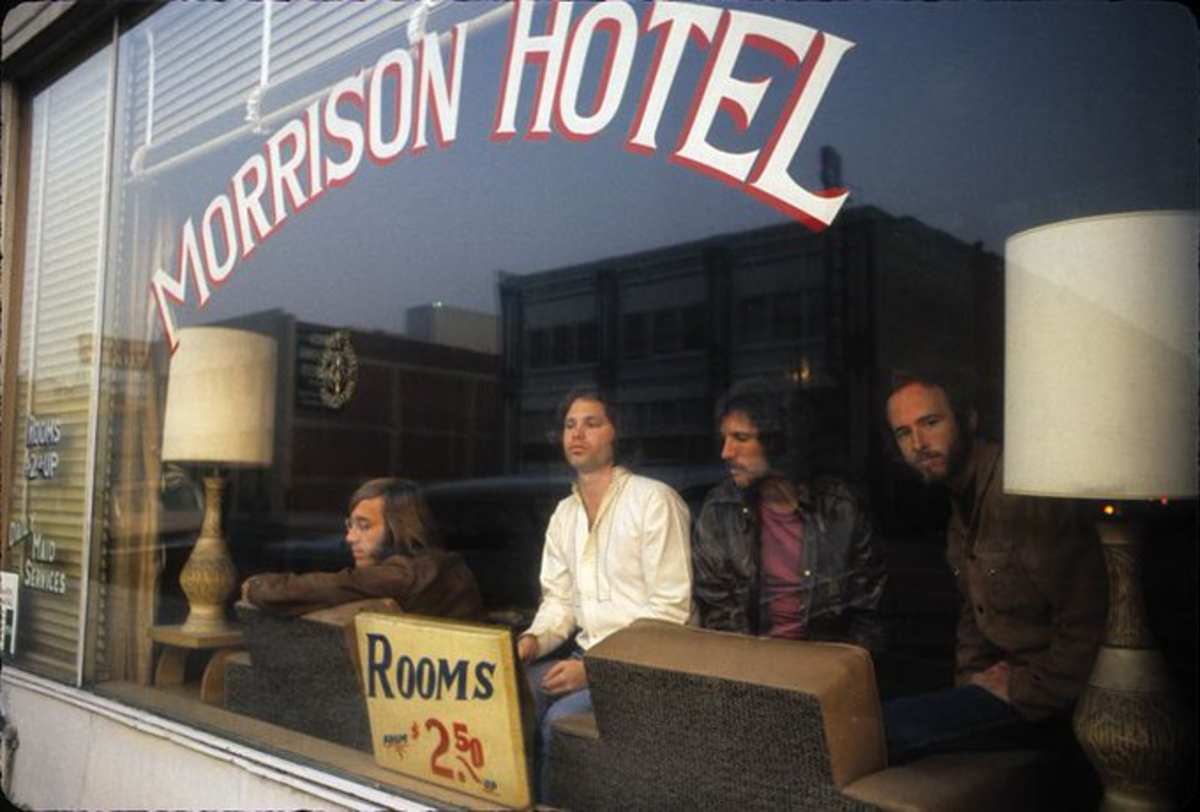
The legend of the "Lizard King" often acts as a shroud, obscuring the awkward, sweating, and painfully shy young man who haunted the Sunset Strip in 1966. To understand the art, one must confront the "process"—the messy, unpolished reality of the Whisky a Go Go. This was not a shamanic birth; it was a student’s labor. We look past the leather-clad swagger to find the "Good Boy" who sought a father’s approval and the "Shy Guy" who had to steal his fire from a namesake.
The Two Morrisons
A Study in Stolen Fire
In June of 1966, the air in the Whisky was thick with more than just smoke. It was the scent of a passing torch. Before Jim became the vessel for our collective darkness, he was an apprentice in the shadows. Opening for the Irish band Them, Jim sat in the dark, his eyes fixed on Van Morrison.
He watched Van cradle the microphone like a weapon; he watched the brooding, volatile silence that commanded the room. Jim wasn’t "Jim" yet. He was a student of chaos, soaking in the performance of a man who already knew how to project a dangerous unpredictability. On the final night, during a joint jam of "Gloria," the dyad was complete: the master and the student, sharing the same stage, the same name, and eventually, the same shadow.
The Good Boy & The Altar
The Paternal Ghost
The myth tells us Morrison was a terror to authority, a rebel against the machine. But the walls of the Whisky tell a different story. In Mario Maglieri—the tough, ex-cop co-owner—Jim found the father figure his own life lacked.
When Mario scold him for his drug use or his behavior, the "Shaman" evaporated. In his place stood a "good boy" with puppy-dog eyes, slurring an affectionate "Oh Mario, I love you." This was the internal dyad: the man who improvised an Oedipal nightmare on stage to agitate the owners he hated, yet sought the quiet, paternal approval of the one man who saw him as a "lost kid" rather than a sex symbol.
The Leather Mask
A Poem on the Shy Guy
The spindle-shadows of the Strip,
Hide the boy who feared the light;
Who sang his songs to the back of the room,
And traded his soul for the night.
He watched the master’s heavy hand,
And learned to weaponize the stand;
Constructing a god of cobalt and bone,
To stand in the place of the man alone.
The swagger was a suit of mail,
A clinical mask for the shy and the frail;
While Mario watched from the edge of the glow,
The "good boy" the world would never know.
SIDEBAR | The Beautiful Disaster: When Iggy Met Jim
Ann Arbor, October 1967
In the fall of 1967, at a University of Michigan homecoming dance, a young Jim Osterberg—not yet Iggy Pop—witnessed the “unflinching” reality of a Doors set gone wrong. By most accounts, the performance was a mess. The band vamped endlessly on the riff to “Soul Kitchen,” sounding, in Iggy’s words, “awful… decrepit and disgusting.”
When Morrison finally lurched onto the stage, “out of his head on acid,” he didn’t bring professional polish; he brought a psychic riot. He sang in a bizarre “Betty Boop” falsetto and openly baited the crowd of jocks until he had to be pulled offstage to avoid a physical brawl.
For the average student, it was a disaster. For Iggy, it was a revelation.
“Look how awful they are, and they’ve got the number one single in the country… If this guy can do it, I can do it. And I gotta do it now.”
Iggy didn’t take the music from that night; he took the permission. He saw that the power of the “Lizard King” wasn’t in technical finesse, but in the willingness to be hated. It was the origin point for the feral antagonism of The Stooges.
Years later, when the surviving Doors asked Iggy to step in as their new frontman, he refused. He called the idea of channeling a dead man’s act “ghoulish.” He had already taken what he needed from Ann Arbor: the realization that one could walk onto a stage as a beautiful disaster and dare the world to watch.
A Note on the Sources
History is the silt beneath the river of myth. These accounts are synthesized from the firsthand testimonies of John Densmore (Riders on the Storm), Linda Ronstadt (Simple Dreams), and the archives of the Whisky a Go Go. The photograph was taken by Henry Diltz